Sunday, November 22, 2009

No to revaluing the CNY


The US is trying to get the Chinese to up the CNY or RMB so that the Chinese will import more from the US (box 8).  This suggetion would not fly as it would put the Chinese into an unacceptably risky position. They have been unambiguously clear that China's contribution is to keep China stable and maintain its growth against their export markets shrinking.

Boxes 1, 2 and 3 is the story of fiscal stimuls taking over from exports. The longer term future is to shift more toward domestic consumption (box 4). If the CNY goes up (box 6) as per US wish and the Chinese chagrined no, going by recent history, money will rush into China worsening the asset bubbles already inflating there. The US hopes to get the Chinese hooked on their consumption habit? See the link between Box 5 and Box 4. In this scenario, the Chinese will find it affordable with super cheap money to buy more from the US and everyone. However the longer term consequences to China would be extremely negative. Kudos to the Chinese leaders astute leadership of their country.

Monday, November 16, 2009

USD carry trade


Box 1, 2 and 3 describe the US attempts to inflate its debt away. Since there are so many foreign holders of US assets, they especially China and Japan are forced to help pay the huge pile of US debt. Indeed we are living that attitude: The USD is my currency but your problem.

USD depreciation (box 3) opens up a massive opportunity for borrowing USD at near zero, even negative cost to buy non-US assets. This is driving up asset markets world wide (box 5). There is a reinforcing loop between Box 4 and Box 5. Massive assets bubbles are being inflated all over the world. They are unsustainable and will burst. As usual, too few people know when it will happen. Go bet the markets at your own risk.

As long as the USD is the reserve currency. The US will succeed at getting the rest of the world to help pay its humongous debt. US fiscal policies and consumer habits must change or she would just at the end of the road become utterly bankrupt and completely uncreditworthy.

Monday, November 09, 2009

Combining Nov 7 and Nov 9 NaviMaps

The NaviMap of November 7, "The Economic Recovery Process" is linked to today's, "Making Sense of Rising Gold Prices" via November 7 Box 9, "> USD weakness" to November 9 Box 3, "> selling USD".

The "The Economic Recovery Process" is the driving force behind "Making Sense of Rising Gold Prices" transmitting its influence via the USD price signal.

Making sense of rising Gold prices


Central banks have too much USD. As they diversify from it, USD weakens. The USD will find hopefully a high bottom because nobody is going to zero on the Dollar. The Americans will decide and the rest of the world will react accordingly. The more tough minded they are, the stronger the Dollar.

Saturday, November 07, 2009

The Economic Recovery Process


You would have to double click on the NaviMap above to see a larger picture.

A few interesting features here.

Box 1 and Box 8
No free hand for the Americans to print money. It is difficult trying to strike a balance. If they could have push even more money into the economy, they can quickly reverse the rising rate of unemployment. This is too risky as foreigners might give up on the dollar. Krugman seems to have ignored this point.

Box 9, 10 and 12
This reinforcing loop on first look does not make sense. USD should in theory strengthen (box 9). The USD doesn't behave according to theory because it is a currency of safety. The USD is the worst reserve currency except for the rest as Soros pointed out.

Hopefully with more of Box 3 and Box 5 at a critical point, when the expected returns from USD assets become attractive again, the USD will strengthen (box 12)

Thursday, September 17, 2009

"Too Big to Fail", "Too Big to take a Pay Cut"...

An article from the NYT, "Where Politics Don’t Belong" caused me to put my thoughts into this NaviMap. It discussed, "Too Big to Fail", i.e., Wall Street, and "Too Big to take a Pay Cut", i.e., the income of doctors.

If governments and here I am using the American one as the example, would to leave the markets to decide what is produced, sold then the government would be much smaller and has less to do. Since politicians need to win voters support, they must always find something to do to continue in office. This result in "more government" (box 1) which inevitably leads to messing with the functioning of the markets (box 2) so that the constituencies they they want to get support have an advantage over others (box 3). Note that this lead to a reinforcing loop.

Special interest influence the process of government for their benefit (box 4). The easiest is to provide money to help politicians win elections. Now another reinforcing loop, and this time between Box 3 and Box 4 enters the picture, which is the current state of affairs. Special interests have taken over the government.

Since no reinforcing loop can go on forever, the limits of growth eventually appears. This lead to Box 5 becoming critical, where  markets becomes increasingly distorted, inefficient and uncompetitive (box 6). Voters get fed up - this is the demoting influence of Box 6 on Box 3. If it hasn't happen already, it would as a matter of course.

Box 6 will compete with Box 4 for Box 3, but with Box 5 becoming more a reality, the underperforming economy eventually give Box 6 the upper hand and Box 4 is vanquished. This is all well and good except that I wonder if this can be achieved peacefully or if the economy could have deteriorated so badly by then for some nations that they just simply spiral down.

Tuesday, September 15, 2009

"Old Normal" vs "New Normal" - A simpler version

Related Post

Yesterday I posted a more complicated NaviMap and offered only a cryptic write up on it.

The NaviMap above was created before the one in yesterday's post. The most important boxes is this NaviMap is the reinforcing loop between Box 2 and Box 4a. Box 4a is in blue to suggest that at the time of creating this NaviMap and even now, it is an objective governments hope to achieve in their effort to shore up the financial system.

Similar to the NaviMap from my previous post, if Box 3 appears before the virtuous cycle between Box 2 and Box 4a materializes, then this would lead to the "New Normal". Box 2 and Box 4a represents the revival of the "Old Normal" when people were making money hand over fist.

Inflation (box 3) will force monetary authorities to rein in liquidity or completely lose credibility. They will do it regardless of the political costs.

Another scenario is the "Old Normal" would last briefly, acting as a big bear trap for many investors. Box 3 will appear and bring the party to a premature end heralding PIMCO's "New Normal".

Monday, September 14, 2009

Where do we go from here: "Old Normal" or "New Normal"


This NaviMap tells two stories. One, how overwhelming government funds were employed to rescue the near collapsing financial system and succeeded. Box 1, Box2, Box A. and Box B. The the story continues with Box 3. (increasing asset inflation) because once fear is driven out liquidity naturally seeks higher return.

Ideally policy makers are trying to achieve one or two virtuous loops of economic growth. This is the hope for reinforcing loop joining Box 2, 3, 4, 2 and/or 2, 3, 4, 5, 2. This is the return to the "old normal" as opposed to the low growth "new normal" PIMCO is planning to live with.

Most economists do not think it is possible to return to the old rate of economic growth any time soon. The hope of politicians is that the printed money would be successful at helping them grow out of their troubles. What is to prevent this from happening?

Firstly the amount of debt is just humongous. Secondly, the financial sector has gone far off the course from lubricating the wheels of commerce. Instead lot of bankers spend most of their time on how to obtain a bigger bonus, and how to pass the tab to someone else if things go wrong. That this misaligment of purposes can somehow end up achieving our socio-economic objectives defies imagination

If given the fairly narrow window of opportunity the two virtuous loops did not appear, then Box 7 will eventually appear. It will effectively abort any possibility for the virtuous loop. Central banks will be forced to drain the liquidity from the system the way Paul Volcker had done before. It would be an environment aptly described in PMICO's "new normal" scenario.

Tuesday, September 08, 2009

China: Towards the Rule of Law

"The Rule of Man" (box 1) is stuck in my mind after I read Zhao Ziyang's book, "Prisoner of the State".

Box 1 describes how China is ruled but to a less degree than when Deng was numero uno.

Note the reinforcing loop between Box 1 and Box 2. The Communist Party knows this is what keeps them in power. As no reinforcing loop can go on indefinitely, fairly early on Box 3 (Corruption) has been growing, which is a demoting influence on Box 2.

In this NaviMap we introduce Box 4 - Social Progress.

Because of Box 2 over the last 30 years, we can talk about Box 4 meaningfully today. However the antagonistic relationship between Box 3 and Box 4 has created a "Tug of War" situation over Box 4. This is feeding back to Box 1 as a promote and demote Box 1 influence.

The Chinese correctly believed that nothing can be done to get China out of its poverty and onto a development path without economic progress (box 2). A worsening corruption situation (box 3) must be managed within the latent strength of their ancient culture. Zhao Ziyang believed that pervasive corruption (box 3) would be temporary. Looking beyond, he had felt that the Rule of Man (box 1) is temporary. Eventually it would yield to the Rule of Law.

Rule of Law (box 5) is the destination that the Chinese wants to be at eventually.

Historically they have never succeeded at scoring a permanent victory over corruption. Why should it be different this time? They are hopeful because the days of the emperors and the paramount ruler are over. Now they have to figure out their own version of democracy. They cannot do this quickly. The pace is dictated by Box 3. and Box 2. Social Progress (box 4) is in the centre of this tug of war. The ride we can be sure has been and will continue to be very bumpy.

Sunday, September 06, 2009

NaviMap now has a companion blog

This blog attempts to cover to much ground. I have started a related blog at http://virtuouscycles.blogspot.com/ which is more focused on understanding and owning the virtuous cycles around us. I welcome you to visit Virtuous Cycles.

Wednesday, May 30, 2007

The Forgiveness Process


When you truly forgive (box 1) you let go of the bad memories that feed your hurt (box 1a), which was simply kept alive by Box 1c because you remember them, perhaps even nurse them! Time can cause your bad memories (box 1a) to fade but only if you do not indulge it by keep on reminding yourself about them (box 1c).

If you can really forgive (box 1), then you will eventually open yourself to rebuilding and begin to have a new view of the future (box 1f). This will help you to have new memories (box 1g) that will replace the bad old ones (box 1a). Finally you can really "forget".

You see what they say about forgiving and forgetting is not completely correct. It is more like forgiveness paving the way for new pleasant memories (box 1g) to take the place of old bad memories (box 1a). This will help you remember the old hurts differently because new memories replace bad old ones. This then is the true meaning of forgetting after you have learned to forgive.

Monday, May 29, 2006

The Dubai Real Estate Bubble


I just visited Dubai and made some observations about its property market. There is a bubble being inflated right now and it can probably get bigger before it pops. Why?

Let's begin with how all bubbles begin. There need to be a trigger otherwise higher property prices will moderate demand and there is no financial bubble.

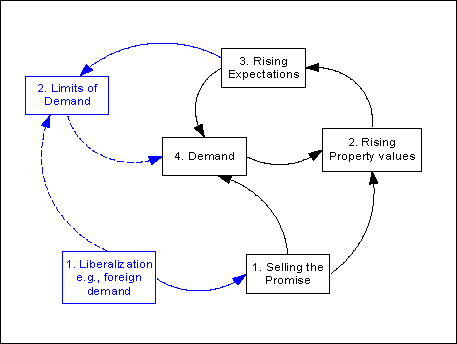
Financial bubbles always come about because buyers believe that prices will go up. The Dubai government has been very successful at selling their city as the key business and life-style location of the Middle East, fashioning it as the Singapore or their region See Box 1 (black box). This led to rising property values as buyers rushed in to bet on the promise and success (box 2). The first wave of buyers provided the indispensable vote of confidence. This creates subsequent waves of higher expectations of property price (box 3), feeding towards even more demand for Dubai properties (box 4).

Eventually prices become so high that demand begins to wane (blue box 2). If this happen, the property bubble is ready to pop. Nobody can anticipate how and when this stage is reached and therefore to prevent a crash the Dubai government has to prepare and always be ready with a set of liberalization initiatives to support greater demand and higher prices (blue box 1). As long as Dubai is willing to keep making foreign ownership more attractive, this bubble can inflate quite a bit more. Of course, as the bubble gets bigger the risk of a crash also become more significant. The wish of any government is to engineer a soft landing but this is not easy to achieve. As of now, this property bubble has more life left in it. So I wouldn't bet for a crash yet, but stay vigilant and use this NaviMap to help you organize your data and understand what is happening in this market.

Monday, August 08, 2005

A Tug of War: The Design Economy Vs Existing Practice


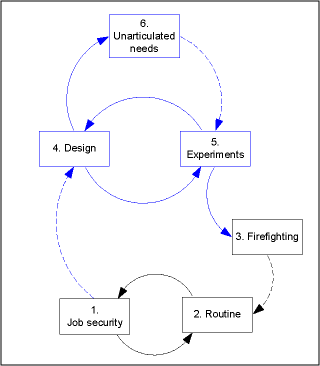
Most of us are not highly paid CEOs, and for a long time, a secure job (Box 1) is one that we perceived as "indispensable" to the organization, and it was easiest to see that it was so if it has a fair amount of routine (Box 2). It was a time when people who drift from project to project without a precise job description were thought to be at risk of losing their jobs. Read: More routine (Box 2) more job security (Box 1). It is a reinforcing loop.

As firms lose control to set prices and determine what to produce and persuade customers to buy, have you noticed that there is more fire-fighting activities in the office these days (Box 3)? It just seemed that the routine processes were just not good enough to supply what the customer wanted. See Box 3, it is an enemy of Box 2.

Then came a generational change. The rise of China and other offshore manufacturing and service centers force developed economies to move up the ladder into more design work (Box 4), which can only be successful by trying out new ideas and daring to fail (Box 5). Box 4 and Box 5 is a reinforcing loop and its objective is to produce goods and services that wow the customer by making those dreams that they haven’t been able to articulate successfully come true. A by product of the reinforcing loop of Box 4 and Box 5 is to create more firefighting situations for those who are "doing the routine work".

There is a tug of war situation between the reinforcing loop of Box 1 and Box 2 and that between Box 4 and Box 5. A conservative business leadership would hold tightly to the old order and see it slip away but a courageous leadership will try to lead as many people to the new world and logic defined by the reinforcing loop of Box 4 and Box 5. It is an uncertain and difficult world because the speed at which the lower rung countries are climbing up the ladder give you pretty little breathing space.

Tuesday, August 02, 2005

Why use NaviMap?

NaviMap is a response to our age of information overload because our human brains are not designed for handling so much information simultaneously. Think of it like the handheld electronic calculator that we routinely use for doing sums or better still, the abacus. Not for numbers but ideas.

I have found research (this is one of many) providing evidence that most humans cannot cope with more than four variables at one time. See the findings of the psychologist from the University of Queensland: How much information is too much information?

Saturday, July 30, 2005

Fading Microsoft and Ascendant Google

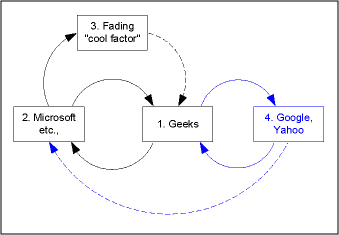
Microsoft owns the world of PC computing. The reinforcing loop between Box 1 and Box 2 underscores that fact. Microsoft pays their geeks especially well to write software (Box 1) and Microsoft’s success (Box 2) in turn attracts more geeks to their ranks. But Microsoft eventually loose their "cool factor" (Box 3) when they fail to continue to be the "happening place". No more sexy products to build or world class problems with world class impact to solve. The virtuous cycle between Box 1 and Box 2 slows when Box 3 appears for Microsoft.

Therefore Microsoft’s stock begins to under perform. It becomes more like a utility than a growth stock. The market however is always looking for growth opportunities. That opportunity is now filled by the likes of Google and Yahoo (Box 4). The virtuous cycle that Microsoft is enjoying is fading and shifting right to a growing virtuous cycle between Box 1 and Box 4. The search engine leaders has the toughest technical problems that attracts the best people with the greatest potential impact on how we use the Internet.

An ascending Google will steal the wind from Microsoft’s sails (see dashed arrow from Box 4 to Box 2) unless Microsoft is able to snatch the wind from someone else. It is trying with its Xbox to usurp Sony’s Playstation, which is perhaps the only other cool place it might have a chance to win.

The best days for Micrososft could be over. A company that expends extraordinary resources on product and service security to raise reliablity fits to a t, a description of what a utility company is. Nowadays you buy Microsoft for the dividends. Look elsewhere if you want growth.

Friday, July 29, 2005

The Life Cycle of a Meritocracy


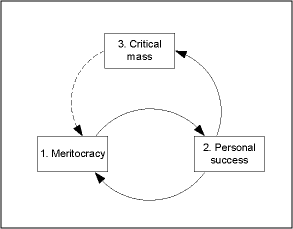
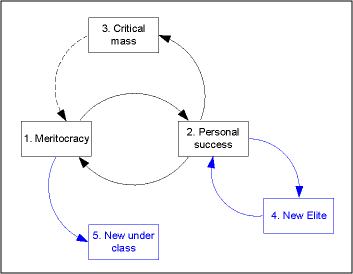
For many years we saw that Meritocracy was good for any society that practiced it. It is a reinforcing loop and a virtuous cycle as shown in the relationship between Box 1 and Box 2. Meritocracy helps to identify and groom the able and make them successful (Box 2).

Unfortunately all good things will eventually decline and come to an end, Meritocracy notwithstanding. It seemed that when a huge numbers of able individuals have been identified and groomed (Box 3), Meritocracy seem to only suggest that the offspring of the successful parents are the most meritorious – See the dashed arrow from Box 3 to Box 1. E.g., The elite schools used to receive students from families with mixed backgrounds, now those who come from humbler families are an increasingly small minority. What are the consequences?


Meritocracy will eventually breeds a new elite that mostly reproduce the next generation of elite. This is the new reinforcing loop between Box 2 and Box 4. The logic of the reinforcing loop between Box 1 and Box 2 becomes yesterday’s logic because Box 3 has appeared to slow the virtuous cycle. At the same time, a new under class will emerge (Box 5).

Eventually the environment will change and the new elite (Box 4) will become the old ossifying elite and get supplanted as they finally fail to adapt to an changed environment. The society might then return to the former logic of Box 1 and Box 2 that will eventually produce the next elite, which is more compatible with the changed external environment. However there is no guarantee that this will happen. The society might enter into a dark age instead of clearing the ground to create the next golden age.

Thursday, July 28, 2005

Globalization: Who Wins


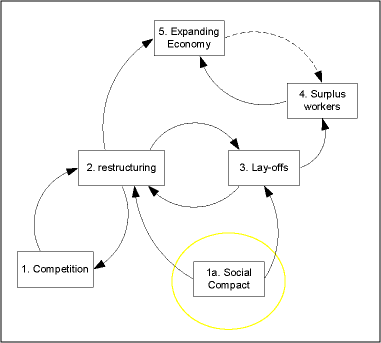
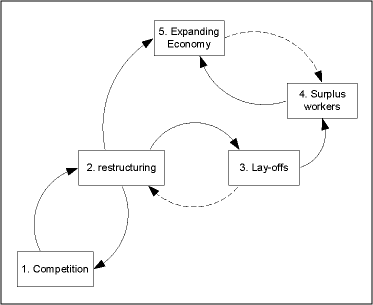
Under normal circumstances the relationship between Box 1 and Box 2 should be a counterbalancing loop rather than a reinforcing one. But if competition is very intense, what results is reinforcing loop. This is the current reality.

Box 2 inevitably leads to laying off workers (Box 3). Also the relationship between Box 2 and Box 3 this should be a counterbalancing loop instead of a reinforcing one. The more workers are laid off, the less willing society is able to tolerate more job cuts. So the arrow from Box 3 to Box 2 should be a dashed arrow. But if a society have forged a very strong social compact (Box 1a), we will see a reinforcing loop instead. And all this is driven by a very powerful Box 1 created by a globalizing environment.

Box 2 is unsustainable unless it yields an expanding economy (Box 5) that is a net creator of jobs, and eventually higher quality jobs. It will soak up the surplus labour (Box 4). If Box 5 accelerates too quickly, then wages will begin to inflate. It is a counterbalancing loop between Box 5 and Box 4.

This NaviMap is similar to the previous case except that Box 1a – the social compact, is absent. In most societies, no matter how intense competition (Box 1) is at pressurizing for restructuring (Box 2), the pace of restructuring is paced by how much that society accepts massive lay offs of workers. The relationship between Box 2 and Box 3 is usually a counterbalancing one. As a result, Box 5 for this scenario is an economy that is expanding more slowly than the previous example. Fewer people are laid off and it is also harder for them to find new jobs compared to the first case. This society will achieve lower economic growth and eventually lower family incomes than the former case.

The MP3 Gadget Wars (Apple, Creative and Others)

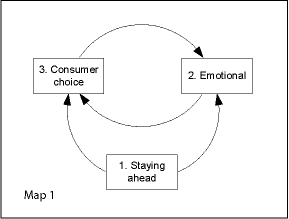
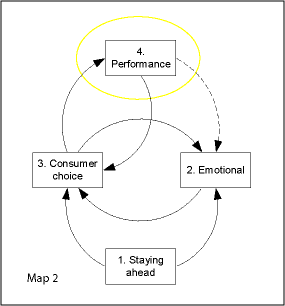
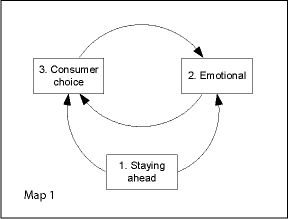
Apple’s ability to stay ahead in the personal digital technology market is their special ability to tell consumers what is cool (something which Sony used to be able to do), i.e., Box 1 in Map 1. Their products, in this instance the iPods are not asking consumers what they want but surprising them with WOW designs in an MP3 player such that they become lifestyle items.

Apple endeavors to bring on products that enjoys the virtuous cycle shown in Map 1 between Box 2 (WOW you emotionall products) and Box 3 (Consumers vote for their products). This virtuous cycle is supported by their Box 1.
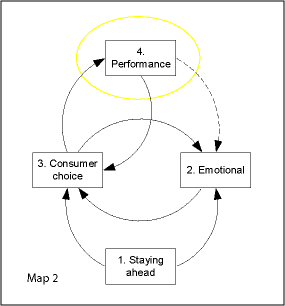


Creative Techology wants to occupy the pole position in MP3 players. Its strategy is to provide superior performance and features at a price point that is better than Apple (Box 4). They hope to own a virtuous cycle as shown between Box 3 and Box 4. Were they successful, the market would have signaled that consumers prefer performance and features (Box 4) over emotional appeal (Box 2). Sales data of the two companies products show that the virtuous cycle between Box 3 and Box 4 for Creative Technology is not as strong at the virtuous cycle between Box 3 and Box 2 that is owned by Apple.


As the market for MP3 players grow and mature, the virtuous cycle between Box 3 and Box 4 should become stronger than Apple’s controlled Box 2 and Box 3. By then Apple would have moved on to something else (Box 1) after Steve Jobs has divined where consumers want to be.
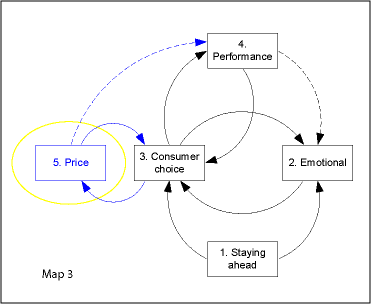
In the meantime, Creative Technology risks being sandwiched by cut throat priced products from the bottom e.g., Samsung, and the iPods from the top – See Box 5. Therefore the window for the virtuous cycle of Box 3 and Box 4 could be so small that Creative’s performance could really suffer. In this game that Creative has entered, they had no choice but to oust Apple or be prepared to move down market and valiantly defend their territory against all comers.

Creative never had Apple’s "Box 1" advantage. The market for MP3 players though growing rapidly, wasn’t fast enough for enough consumers to be part of Creative virtuous cycle (i.e., Box 3 and Box 4). When the market becomes much larger, it will also be the time when it is crowded with many competing suppliers. Prices for MP3 players can only head south. Another round of severe cost cutting at Creative looks inevitable as it fights for survival and fashions a comeback strategy.

End of the smarter sales strategy


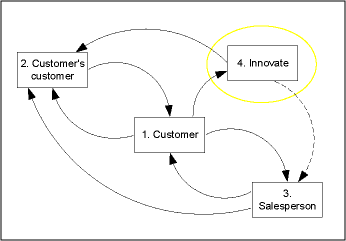
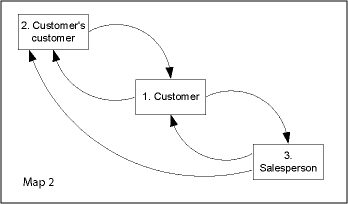
This continues from yesterday’s post. No reinforcing loop last forever. In the above diagram, there are two such reinforcing loops between Box 1 and Box 2, Box 1 and Box 3. One possibility is that Box 1 might at some point in time innovate (Box 4) on what it offers to Box 2. Well that might keep Box 2 happy by anticipating your coustomer’s needs, it is likely to disrupt the reinforcing or virtuous cy cle between Box 1 and Box 3 (see dashed arrow). If Box 3 fail to respond successfully, the virtuous cycle between Box 1 and Box 3 slows or ends.


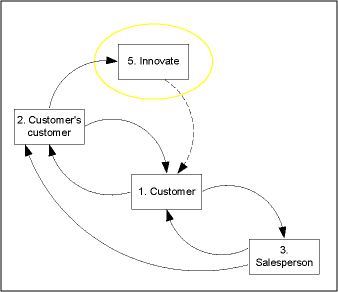
In an alternative scenario as shown above, Box 2 instead Box 1 could be the innovator (Box 5). If Box 1 fails to respond successfully to Box 2 changing requirements then the virtuous cycle between Box 2 and Box 1 will be negatively impacted. This will als be to the detriment of Box 3.

There are other possibilities to these two scenarios but the important point to take away is that no virtuous cycle or reinforcing loop lasts forever. So if you have worked your way to a sweet spot, do not be complacent.

Wednesday, July 27, 2005

The smarter sales strategy


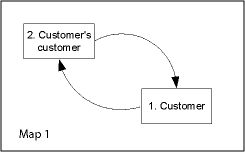
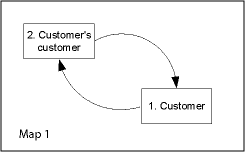
If you are a salesperson, your best customers are those who are themselves enjoying healthy and repeated sales with the customer’s customer. Such a story is shown in Map 1 as the virtuous cycle between Box 1 and Box 2.


If you are the salesperson, the smart strategy is not concentrating your efforts solely on Box 1. Instead, focus on Box 2, which will offer you the insight needed to serve Box 1 better. Your objective is to understand the nature of the virtuous cycle between Box 1 and Box 2 as well as possible. The quality of a virtuous cycle of repeat sales, i.e., between you (Box 3) and your customer (Box 1) will be determined by your relationship with the customer’s customer (Box 2).